
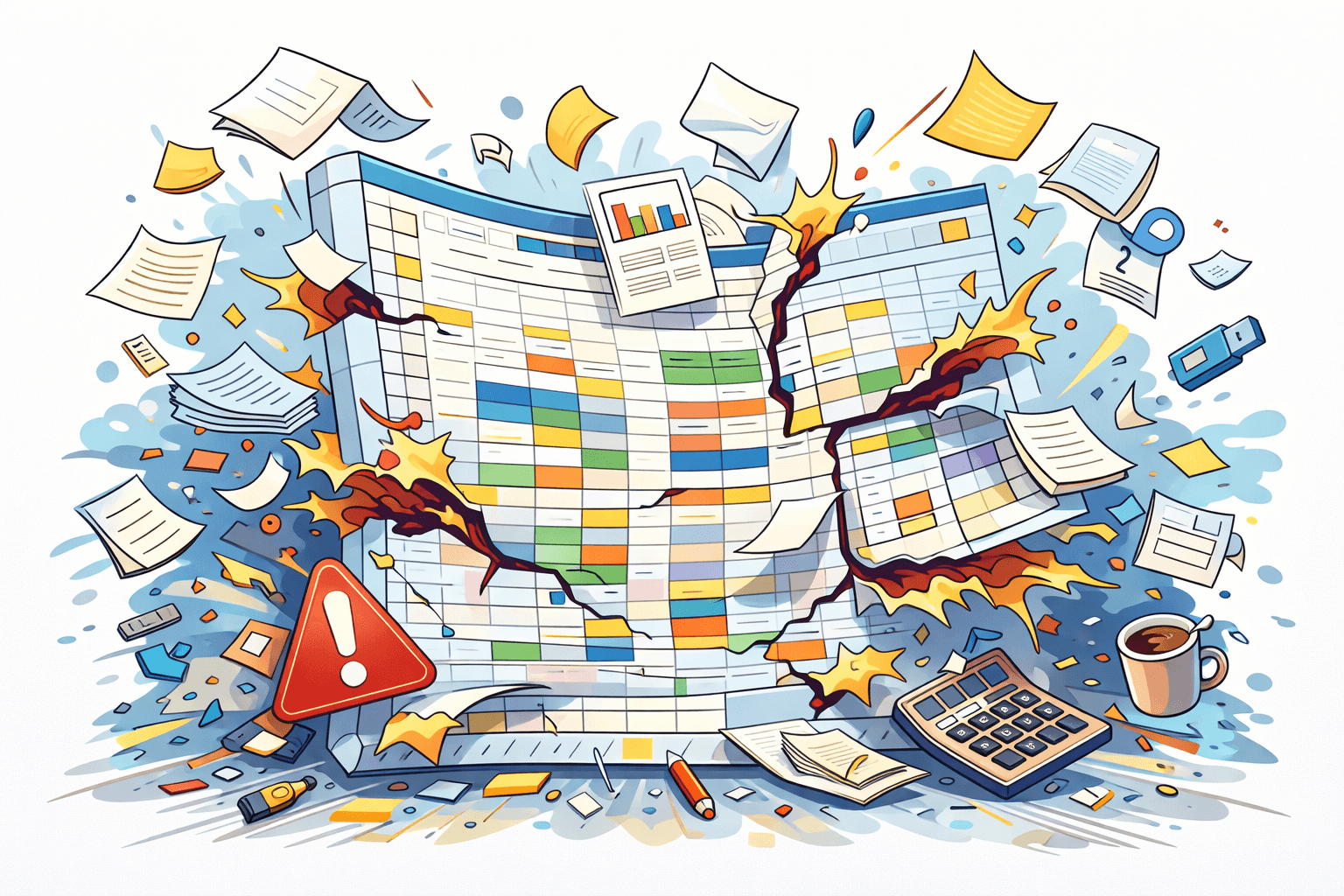
It Always Starts With a Spreadsheet — Then You Outgrow It
There's nothing wrong with spreadsheets. They're flexible, familiar, and free. For a small team managing a handful of orders per week, a well‑organized Google Sheet or Excel file is a great place to start.
Spreadsheets are where modern businesses start their operations. They’re the first place ideas turn into numbers. Revenue projections, inventory lists, pricing models, vendor contacts—all neatly organized into rows and columns.
For a while, this works. But as teams start scaling operations, the gap between spreadsheets vs ERP systems begins to show—especially once growth demands shared visibility, real-time updates, and tighter coordination.
But spreadsheets were never designed to run a growing business. They were designed to calculate things, not to coordinate people, processes, and decisions.
Somewhere along the way, things start to break.
The formulas get fragile. The tabs multiply. Permissions become a mess. Three people are editing the same file, and nobody knows which version is current—or worse, which numbers are correct.
What once felt empowering starts to feel shaky.
The Warning Signs
It usually doesn’t fail all at once.
It fails on a Tuesday afternoon—when a shipment goes out short because someone was working from an outdated tab. Or when finance realizes, a week too late, that cash is tighter than expected because a formula broke. Nothing dramatic. Just enough friction to slow everything down.
Here are some of the signs you've outgrown spreadsheets:
Data lives in someone's head
If your ops manager is the only one who understands the inventory sheet, that's a single point of failure—not a system. When knowledge isn’t encoded into software, it walks out the door at 5pm.
You're copy‑pasting between tools
Moving data from your invoicing tool to your spreadsheet to your reporting dashboard opens the doors to errors, delays, and wasted time. Manual handoffs don’t scale—and they never will.
You can't answer basic questions quickly
"What's our cash position right now?" or "How many units can we actually ship this week?" shouldn’t take 45 minutes and five emails to answer. If insight lags behind reality, you're making decisions without all the information.
Mistakes show up downstream
A missed formula, a hidden row, or an accidental overwrite doesn’t fail loudly—it fails quietly. You only notice when inventory is short, orders are late, or customers are upset.
Onboarding takes weeks
New hires shouldn’t need a guided tour of 12 interconnected spreadsheets to do their job. If training relies on tribal knowledge, growth grinds to a halt.
Reporting feels like archaeology
If pulling a monthly report feels like digging through layers of historical data just to reconstruct what happened, your tools are working against you.
These aren’t edge cases. These aren't problems isolated to you and your business. They’re signals that your business has evolved—but your tools haven’t.
Why Spreadsheets Stop Scaling
At a certain point, growth stops being about more effort and starts being about better business systems. Without a single source of truth and real operational visibility, spreadsheets collapse under the weight of coordination they were never designed to handle.
Spreadsheets struggle for one simple reason: they’re isolated.
Each sheet is its own universe. Inventory doesn’t inherently know about sales. Purchasing doesn’t automatically reflect demand. Changes in one place don’t propagate cleanly to another.
As soon as multiple departments depend on the same data, spreadsheets turn into a coordination problem.
You don’t need more tabs. You need shared context.
Modern businesses require systems that:
-
Maintain a single source of truth
-
Enforce consistency without rigidity
-
Update in real time as work happens
-
Reflect how your business actually operates—not how a template assumes it should
This is the gap spreadsheets were never meant to fill.
Modern Tools for Modern Businesses
Modern businesses deserve modern tools—and they shouldn’t have to wait until they’re broken to get them.
That sounds obvious—but the software market hasn’t caught up.
For decades, businesses have been forced into a false choice: limp along with spreadsheets until things break, or leap into bloated enterprise ERP systems designed for another era.
Why should this be your only option?
The problem isn’t choosing a real system too early. The problem is choosing software that assumes your business must become slow, rigid, and consultant‑dependent as it grows.
Traditional ERP systems solve coordination by piling on process. Long implementations. Consultant armies. Workflows modeled after Fortune 500 org charts—not the way modern teams actually operate.
Those systems aren’t the inevitable end state. They’re a legacy compromise.
The bottom line is that world is moving faster than ever. Successful businesses must be able to move quickly, and react even faster.
OpOtter is built on a simple belief: the first real system you adopt should be the last one you ever need to replace.
We’re building OpOtter for teams who are scaling fast, thinking long-term, and don’t want their tools to be the thing that slows them down.
OpOtter is not a temporary bridge. Not a stepping stone. It should be the foundation your business grows on.
Modern businesses shouldn’t have to “graduate” to better software later. They should have access to modern, connected, real‑time systems the moment spreadsheets start cracking. OpOtter gives you the power of an ERP without the weight of enterprise baggage.
It’s what business software looks like when it’s designed for today's world. When it's design by users, for users.